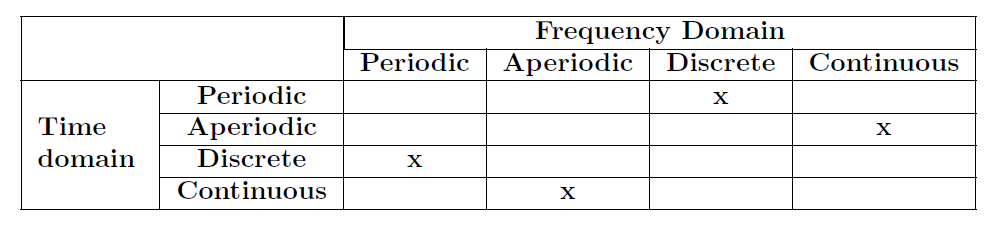
Motivation for the definition of Fourier transform is often given as to capture the individual frequency components of periodic function(or, in the discrete-time case, a periodic series).
The frequency components (basis in Linear Algebra terms?) that express the periodic function are of the form 

Note that, in this article, we refer to independent variable of the original (call it original, for lack of a better word) function to be time, while the independent variable of the transform function to be frequency. And, we refer to a function of a real variable to be a continuous function, while we refer to a function defined on the set of integers to be a discrete function. Combining the two, we refer to:
- an original function of a real variable as a continuous-time function
- an original function defined on the set of integers as a discrete-time function
- a transform function of a real variable as a continuous-frequency function
- a transform function defined on the set of integers as a discrete-frequency function
A continuous-time periodic function 


where 

An observation that can be made is that the Fourier expression of a periodic continuous-time function is a discrete-frequency aperiodic function.
Next, consider a discrete-time periodic function ![x[n]](https://s0.wp.com/latex.php?latex=x%5Bn%5D&bg=ffffff&fg=000000&s=0 "x[n]")

![x[n] = \frac{1}{N}\sum\limits_{k=\langle N\rangle} a_k e^{j\frac{2\pi}{N}nk}](https://s0.wp.com/latex.php?latex=x%5Bn%5D+%3D+%5Cfrac%7B1%7D%7BN%7D%5Csum%5Climits_%7Bk%3D%5Clangle+N%5Crangle%7D+a_k+e%5E%7Bj%5Cfrac%7B2%5Cpi%7D%7BN%7Dnk%7D&bg=ffffff&fg=000000&s=0 "x[n] = \frac{1}{N}\sum\limits_{k=\langle N\rangle} a_k e^{j\frac{2\pi}{N}nk}")
![a_k = \frac{1}{N}\sum\limits_{n=\langle N\rangle} x[n] e^{-j\frac{2\pi}{N}nk}](https://s0.wp.com/latex.php?latex=a_k+%3D+%5Cfrac%7B1%7D%7BN%7D%5Csum%5Climits_%7Bn%3D%5Clangle+N%5Crangle%7D+x%5Bn%5D+e%5E%7B-j%5Cfrac%7B2%5Cpi%7D%7BN%7Dnk%7D&bg=ffffff&fg=000000&s=0 "a_k = \frac{1}{N}\sum\limits_{n=\langle N\rangle} x[n] e^{-j\frac{2\pi}{N}nk}")
In this case, we have a discrete-time periodic function and we find that its Fourier expression is a periodic discrete-frequency function. Note that, we only add finite number (
Now, we consider the most general case which is an aperiodic continuous-time function


The Fourier transform of an aperiodic continuous-time function is a continuous-frequency aperiodic function.
We could consider the final case of an aperiodic discrete-time function
![x[n] = \frac{1}{2\pi}\int\limits_{2\pi}X(\omega)e^{j\omega n}\,d\omega](https://s0.wp.com/latex.php?latex=x%5Bn%5D+%3D+%5Cfrac%7B1%7D%7B2%5Cpi%7D%5Cint%5Climits_%7B2%5Cpi%7DX%28%5Comega%29e%5E%7Bj%5Comega+n%7D%5C%2Cd%5Comega&bg=ffffff&fg=000000&s=0 "x[n] = \frac{1}{2\pi}\int\limits_{2\pi}X(\omega)e^{j\omega n}\,d\omega")
![X(\omega) = \sum\limits_{n=-\infty}^{\infty}x[n]e^{-j\omega n}](https://s0.wp.com/latex.php?latex=X%28%5Comega%29+%3D+%5Csum%5Climits_%7Bn%3D-%5Cinfty%7D%5E%7B%5Cinfty%7Dx%5Bn%5De%5E%7B-j%5Comega+n%7D&bg=ffffff&fg=000000&s=0 "X(\omega) = \sum\limits_{n=-\infty}^{\infty}x[n]e^{-j\omega n}")
The Fourier transform (called discrete-time Fourier transform) of an aperiodic discrete-time function is a continuous-frequency periodic function.
What is interesting to note is how periodicity maps to discreteness.