Observations on power, exponential and logarithmic functions

Power functions namely functions of the form x^\alpha where \alpha is a real number, the exponential function e^x and the logarithmic function \ln(x) appear all the time in mathematics. They may appear by themselves or as part of compound expressions such as \frac{x^2}{x^3+1}, \frac{1}{e^x+1} or x\ln(x). It is essential for any student of mathematics to have firm grasp of these functions and visualize the pattern in this collection of functions. In this article, we restrict our attention to x \ge 0 because x^\alpha\notin \mathbb{R} if x < 0 for certain values of \alpha. Also, \ln(x)\notin\mathbb{R} if x < 0.

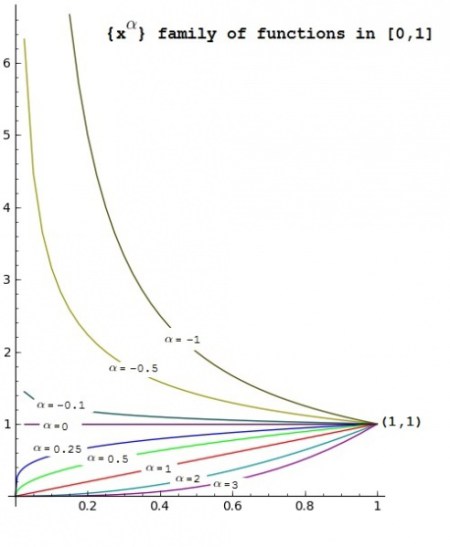
  • For \alpha > 0, x^\alpha is a strictly increasing function. That is, for any x_1, x_2 \ge 0 with x_1 < x_2, we have x_1^\alpha < x_2^\alpha.
  • For \alpha < 0, x^\alpha is a strictly decreasing function. That is, for any x_1, x_2 \ge 0 with x_1 < x_2, we have x_1^\alpha > x_2^\alpha.
  • Of course, for \alpha = 0, x^\alpha is identically equal to 1, a constant.
  • x^\alpha = 1 for x = 1 for all values of \alpha.
  • If x\in(0,1), the family of functions \{x^\alpha\}_{\alpha\in\mathbb{R}} is decreasing. That is, if \alpha_2 > \alpha_1, we have x^{\alpha_2} < x^{\alpha_1} for each x\in(0,1).
  • XToAlphaFrom0To1

  • If x > 1, the family of functions \{x^\alpha\}_{\alpha\in\mathbb{R}} is increasing. That is, if \alpha_2 > \alpha_1, we have x^{\alpha_2} > x^{\alpha_1} for each x > 1.
  • As x\rightarrow\infty, the function e^x grows faster than any x^\alpha for any \alpha > 0 no matter how big \alpha is. That is, e^x - x^\alpha\rightarrow\infty as x\rightarrow\infty for \alpha > 0 no matter how big \alpha is.
    • In fact, \beta^x - x^\alpha \rightarrow\infty as x\rightarrow\infty for \alpha > 0 and \beta > 1 no matter how big \alpha is and how small \beta is. For example, \lim\limits_{x\to \infty}\frac{x^{100000000000000000000000000}}{1.00000001^x} = 0.
  • As x\rightarrow\infty, the function \ln(x)\rightarrow\infty. However, as x\rightarrow\infty, \ln(x) (or, more generally,
    \log^x_{\beta}) grows slower than any x^\alpha for any \alpha > 0 (and for any \beta > 1) no matter how small \alpha is (and how small \beta is). That is, x^\alpha > \log^x_{\beta} and in fact, x^\alpha-\log^x_{\beta}\rightarrow\infty as x\rightarrow\infty for \alpha > 0 and \beta > 1 no matter how small \alpha is and how small \beta is.

Leave a Reply

Your email address will not be published. Required fields are marked *

Scroll to top